Facial fat grafting restores volume lost from GLP-1 weight loss. Learn how it works, survival rates, recovery, and results vs. fillers in Singapore.
September 26, 2026


Public parking available or drop off along Arab Street, Village Hotel Bugis (Previously known as Golden Landmark Hotel)
Buses (2, 12, 32, 33, 130, 133, 133A, 520, 960, NR7) MRT (alight at Bugis MRT station)


Think liposuction helps you lose weight? Here's what fat cells actually do after the procedure, and how GLP-1s medications can help you with weight loss.

If you've spent years working out and eating well, only to still see the same stubborn pocket of fat on your belly, thighs, or arms, it's a genuinely frustrating place to be. It's also the exact reason so many people start researching liposuction and hoping it might also move the number on the scale. It's a reasonable question to ask. Here's the direct answer: liposuction does not cause weight loss. It removes fat volume from targeted areas, not overall body weight.
"This is the most common misunderstanding I've noticed in patients. Liposuction targets fat volume, not scale weight. Fat is surprisingly light, so removing even a significant volume of it may only cause a minimal change on the scale. The goal is to reshape stubborn areas, not to lower your overall body weight," says Dr Ivan Puah, an MOH-accredited liposuction doctor in Singapore who designed a body transformation programme combining surgical, medical, and non-invasive approaches tailored to each patient.
If you're dealing with stubborn fat that hasn't responded to consistent diet and exercise, or a body-fat distribution that seems to run in your family no matter what you try, that's a normal experience, and it's the specific problem liposuction is designed to address, not a personal failing on your part.
Liposuction and weight loss are measuring two different things:
| What it measures | What changes | |
|---|---|---|
| Liposuction | Fat volume in a targeted area | Fat cells are permanently removed from that area |
| Weight loss | Total body mass on a scale | Existing fat cells shrink, but generally stay the same in number |
Fat is a low-density tissue, so removing even a visible amount of it during liposuction may only shift the scale by a few hundred grams. The visible change comes from reshaping a specific area, not from a drop in total body weight.
To understand why liposuction and weight loss behave so differently, it helps to know how fat cells, or adipocytes, function in the body. These cells store energy, provide insulation, and release hormones that regulate metabolism.
When you gain weight, existing fat cells expand, sometimes up to six times their original size. When you lose weight, those same cells shrink, but in most cases, they don't disappear.

The total number of fat cells in your body is largely set during adolescence and stabilises by around age 20 to 22. From that point on, most adults carry a relatively fixed number of fat cells, estimated at roughly 30 billion, that stays stable regardless of weight fluctuation [1].
During childhood and the teenage years, fat cell count increases fairly quickly, and children who gain significant excess weight during this window tend to develop a higher lifetime fat cell count [2].
In adulthood, that count stays largely fixed. Weight gained as an adult is mostly stored by existing cells getting larger, not by the body creating new ones.
With extreme or prolonged weight gain, once existing fat cells reach their storage capacity, the body can occasionally recruit precursor cells to form new fat cells, even in adulthood.
This is also why keeping weight off can be so difficult for some people. Research following individuals after significant weight loss, including after bariatric surgery, found that fat cell count remained essentially the same two years later. The cells were simply smaller, holding less fat than before, but they never disappeared, meaning the underlying capacity to regain weight persisted [3]. If you've regained weight after working hard to lose it, this is a physiological reality your body is working against, not evidence that your effort wasn't enough.
Liposuction works differently. Because it physically removes fat cells from a treated area rather than simply shrinking them, results in that specific area being considered permanent, provided your weight stays relatively stable afterward.
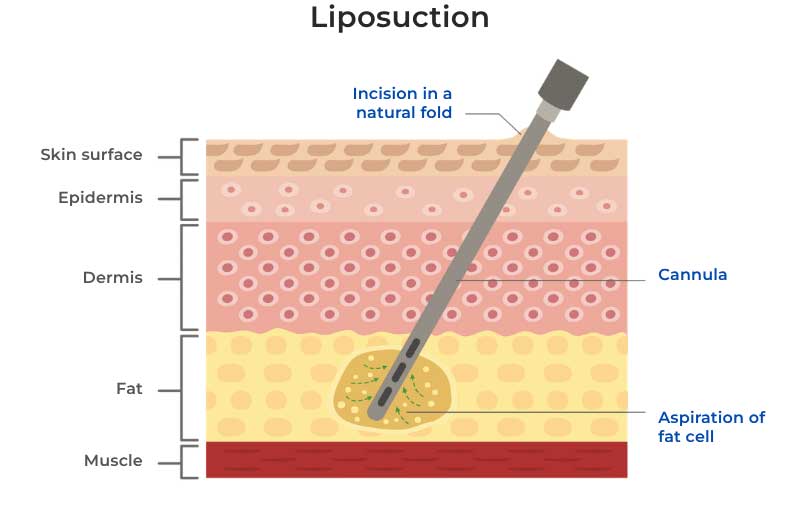
The word "liposuction" comes from the Greek lipo (fat) combined with the English word "suction." It's a surgical body-contouring procedure that removes small, stubborn pockets of fat from specific areas, commonly the abdomen, thighs, arms, or flanks. It reshapes and refines proportions. It is not designed, and should not be used, as a method for overall weight reduction.
An example of a lipo technique is Vaser liposuction. It uses ultrasound energy to liquefy fat into a buttery consistency before it's suctioned out, while leaving surrounding connective tissue, muscle, and blood vessels largely undisturbed. In the hands of an experienced lipo doctor, this approach can also enhance visible muscle definition, which is why it's often chosen by people working toward a more sculpted appearance rather than simple fat reduction.
Liposuction permanently removes the fat cells taken from the treated area. Once swelling resolves, the skin in that area typically conforms to its new contour.
How well the skin retracts depends on a few factors:
Because the treated area has fewer fat cells overall, significant future weight gain is more likely to show up in untreated areas of the body. This is a normal, expected outcome and not a sign that the procedure "failed", it's simply how a body with an altered fat cell distribution responds to new weight gain.
These two procedures solve different problems, and understanding the distinction can save you time, money, and disappointment.
Bariatric surgery is designed for significant, sustained weight loss in people with obesity. Depending on the type of procedure, it works by restricting food intake, reducing nutrient absorption, or both, and it's typically recommended after other approaches haven't produced lasting results.
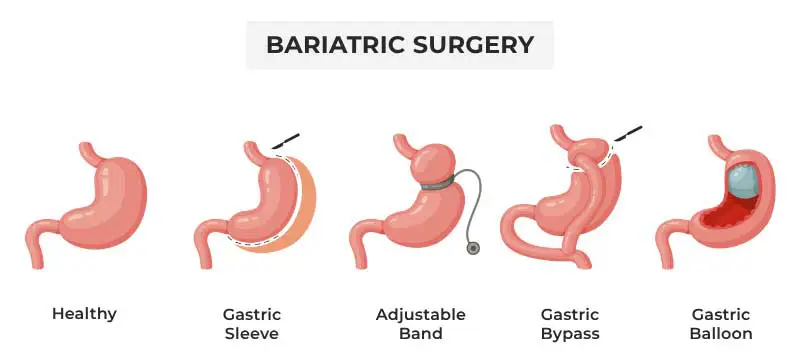
This generally include those who have:
Liposuction is not a substitute for this. It's suited to people who are already close to a stable, healthy weight but have specific areas of fat that haven't responded to lifestyle changes.
If your BMI falls well outside the healthy range, a liposuction doctor may recommend addressing your overall weight first, since both safety and the quality of results depend heavily on how much fat can be removed responsibly in a single procedure.
This is a newer question, and a fair one, given how common GLP-1 medications have become.
Bariatric surgery and GLP-1 medications both support significant weight management, but through different mechanisms. Surgery creates a permanent anatomical change; GLP-1 medications work by mimicking the hormones that signal fullness, without surgery. Some patients and doctors use both together, either using a GLP-1 medication before surgery to support pre-op weight loss, or afterward to help manage weight regain [4].
Liposuction fits into this picture at a later stage. It's most appropriate for people who have already lost weight, through GLP-1 medication, bariatric surgery, or lifestyle change, but are left with stubborn, localised pockets of fat, commonly around the abdomen, thighs, hips, buttocks, arms, or neck, that didn't resolve on their own.
Liposuction and weight loss solve different problems. Weight loss shrinks the fat cells you already have; liposuction permanently removes fat cells from a specific area. If your goal is a lower number on the scale, sustainable weight loss through diet, exercise, or medical options like GLP-1 medications is the right path. If your goal is reshaping a specific area of stubborn fat that hasn't responded to those efforts, liposuction may be worth discussing with an MOH-accredited liposuction doctor.
You should not expect to lose weight from liposuction itself. Any weight change afterward comes from your own sustained efforts with a calorie-controlled diet and regular exercise, not from the procedure. Liposuction changes your shape in the treated area; it doesn't change what the scale reads.
That's an aggressive target for most people. On average, people taking GLP-1 medications lose around 2% of their body weight per month. For someone weighing 90kg, that translates to roughly 2kg per month, so 10kg in 2 months would be well above the typical range. Actual results vary based on starting weight, dose, diet, activity level, and individual metabolism.[5]
Like all medications, GLP-1 drugs carry risks. The most common side effects are nausea and diarrhoea. Less common but more serious risks include gallbladder disease, pancreatitis, and kidney complications. Treatment is generally limited to a 2-year course, and the long-term effects beyond that window are still being studied. If you're considering starting one, this is worth discussing directly with your prescribing doctor against your personal health history.
Underlying conditions, including diabetes, can blunt the amount of weight lost on these medications. If you're not seeing results, it may be worth discussing a dose adjustment with your doctor, or exploring whether a different medication or approach is a better fit for your body. This isn't unusual, and it doesn't mean the medication has failed you.
Yes, for most people it does. Tracking food and activity builds awareness of eating patterns that are easy to lose track of otherwise, and it gives you and your doctor real data to work from. Pairing this with regular movement, cardio combined with resistance training tends to work well, supporting both weight management and general health. Starting small matters more than starting hard: a 15–20 minute walk three to four times a week after meals is a realistic entry point that you can build on gradually.
Two things are typical: incision scarring and post-procedure discomfort. Lipo doctors generally place incisions in inconspicuous locations and keep them as small as possible. You'll be given aftercare instructions to support proper healing, along with pain relief medication. Some soreness and discomfort in the days afterward is expected, but it should be manageable, not overwhelming. If pain feels severe or unusual, contact your doctor.
Yes, consistently, for as long as your doctor recommends. It plays a real role in recovery: reducing swelling and supporting skin retraction in the treated area. It can feel restrictive, but skipping it, or wearing it inconsistently, can slow healing and affect your final results.
Avoid heavy household chores, lifting heavy objects, and high-intensity workouts like weightlifting or HIIT in the initial recovery period. Water-based activities such as swimming, hot tubs, and saunas should also be avoided until your doctor clears you. That said, gentle walking is actually encouraged early on to reduce the risk of blood clots and support circulation, and most people can return to light daily activity, including work, within a few days. Your doctor will guide the exact timeline based on how your recovery is progressing.