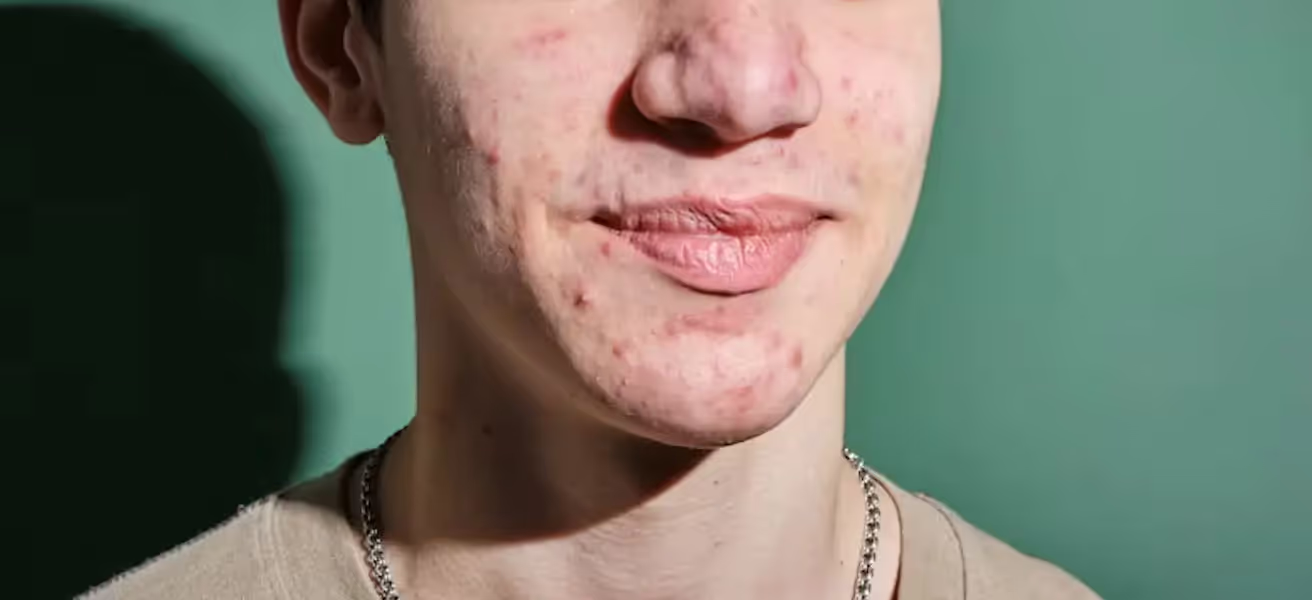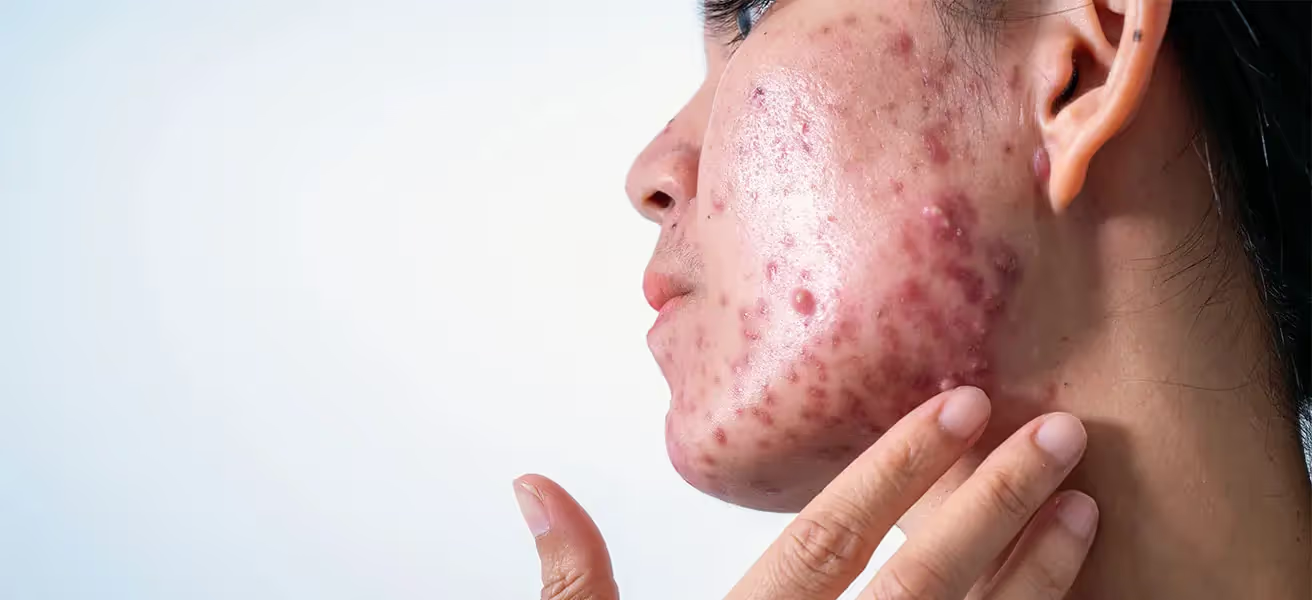
How to identify your acne type, Occurrence of Acne in Singapore
Occurrence of Acne in Singapore among adults & teens, acne differences between males & females, how to identify acne types & FAQ in the Singaporean context.
June 12, 2025


Public parking available or drop off along Arab Street, Village Hotel Bugis (Previously known as Golden Landmark Hotel)
Buses (2, 12, 32, 33, 130, 133, 133A, 520, 960, NR7) MRT (alight at Bugis MRT station)


Many of us in Singapore share a common beauty goal: Achieving clearer, more even complexion. But over time, this has become quite a challenge, especially since the wrong laser treatment can worsen the skin condition, triggering post-inflammatory hyperpigmentation.
Pico Fractional Laser is a safe skin laser for Asian skin, as it delivers ultra-short pulses of energy without heat, making it significantly safer for skin types prone to dark spots after irritation.
At Amaris B. Clinic, Pico Fractional Laser is used to treat a wide range of concerns, such as acne scars, pigmentation, enlarged pores, dull skin, and melasma.
Book a consultation with Dr Ivan Puah at Amaris B. Clinic in Singapore today.
While many things affect our complexions, such as genetics and environmental factors, it does not mean that achieving radiant skin is impossible.
Pico Fractional Laser, the signature treatment of Amaris B. Clinic, can effectively treat enlarged pores and acne scarring and rejuvenate your skin.
This multi-function laser is non-invasive and delivers noticeable and improved results in lesser sessions than other comparables!
It is a treatment suited to treat a variety of skin concerns such as:
It can also be used for general skin rejuvenation.

How it works:
With its multiple treatment wavelength capabilities and being a picosecond laser, Pico Fractional Laser delivers ultra-short laser pulse - without heat - to targeted problem areas.
Benefits:
Targets the skin’s pigment cells, breaking them up into tiny particles, which are then safely and naturally eliminated by the body.
Addresses dermal and epidermal pigmentation issues in a shorter time.

How it works:
Its LIOB technology works to stimulate elastin production.
Benefits:
A softer, fuller and more youthful complexion.
Minimises the appearance of wrinkles and fine lines.
Reduces pigmented lesions.Improves acne scars (which are notorious for a treat).

How it works:
Although the pulses of energy are highly concentrated, the laser’s effect is gentle on the outer skin layer.
Benefits:
Potential discomfort and trauma to the skin are minimised.
Skin heals faster with less downtime.
Pico Fractional Laser is a versatile treatment that is suitable to be used on almost all skin types.
It is competent in the treatment of Asian and/or darker skin, which carries a high probability of post-inflammatory hyperpigmentation.
The treatment can do this by minimising the heat transfer while delivering stronger energy to targeted areas.

Minimises dark spots and discolouration on the skin.
Reduce spots and pigmentation.
Encourages collagen production, resulting in clearer and brighter skin.

Treats acne scarring by first creating thermal injury on the targeted area.
The injured skin will then trigger the body’s natural healing cycle.
After collagen production is stimulated, skin repairing and remodelling will take place.
May be done as a solo treatment or combined with steroid injection, facial fat grafting or subcision.

After collagen production is stimulated, the skin gets smoother and firmer.
Its four different wavelengths enhances its ability to remove more pigments in less time, improves skin tone, and aids in skin rejuvenation.

Research supports its safety and efficacy in Asian skin types, with reduced risks of hyperpigmentation or post-inflammatory discolouration.
Postinflammatory hyperpigmentation results in dark spots on the skin following inflammation. It's more common in darker skin types (III to VI) due to increased melanin.
This occurs following issues such as acne or injury, as with a typical laser treatment, where the spot appearance varies based on melanin depth and skin type[1].
PICO Fractional laser significantly mitigates the chances of developing post-inflammatory hyperpigmentation in all Asian skin tones.
Unlike other lasers, Pico Fractional Laser does not destroy melanosomes and surrounding tissue, making it safer for darker-skinned individuals[2].
Effectively treats different types of Asian hyperpigmentation with fewer complications, due to its photomechanical effects and laser-induced optical breakdown[3].
The ultra-short pulses of laser light minimise heat, reducing the risk of skin damage and post-inflammatory hyperpigmentation.
Safely improves skin quality, especially for Asians who may get dark spots after irritation.
Protecting your skin from the sun and managing environmental factors helps achieve the best results[4].
Acne scars, especially deep or mixed types, require more than just a one-size-fits-all treatment.
At Amaris B. Clinic, we approach skin improvement through a multi-layered combination therapy, using Pico Fractional Laser with complementary treatments such as subcision, and dermal fillers.
This strategy helps us address scarring at multiple levels of the skin, delivering results that are both noticeable and lasting.

The Pico Fractional Laser penetrates through different layers of the skin; targeting superficial pigmentation, mid-dermal collagen loss, and deep scar tissues.
It stimulates neocollagenesis (new collagen production) with minimal damage to the surface layer, which is crucial for faster recovery.
Different types of acne scars, like rolling, boxcar, or ice-pick, respond better when treatment is customised.
Our protocol may combine:

Subcision to release tethered scars, especially rolling scars
Dermal fillers to lift depressed areas and support the skin post-subcision
Pico Fractional Laser to remodel collagen and even out skin tone
Each component plays a role in targeting scars at different depths and in various stages of healing.
Clinical evidence shows that pairing subcision with filler or laser leads to significantly better results than standalone procedures[5].
By combining treatments strategically, we not only improve results but also support faster recovery.
Pico laser triggers collagen production, while adjunct therapies such as fillers or regenerative peels support skin hydration, elasticity, and healing.
In Singapore, treatments such as lasers are regulated by the Ministry of Health. Only registered and certified medical doctors with adequate training can perform the treatment.
Dr Ivan Puah, the Medical Director of Amaris B. Clinic, holds a Graduate Diploma in Family Dermatology from NUS and boasts over 17 years of clinical experience in addressing various dermatological concerns. His proficiency encompasses the treatment of skin laxity, wrinkles, fine lines, hyperpigmentation, acne scarring, and more.
Dr Puah's knowledge and skill are further acknowledged through his appointment as a trainer-to-doctor by Merz Singapore and Allergan Singapore.

Is there any downtime with Pico Fractional Laser?
Downtime is minimal. Patients generally will experience some mild facial redness for a couple of hours after treatment.
In the days following that, the face may feel slightly itchy and rough as the rejuvenation process begins.
What to tell or ask the doctor during consultation?
During the consultation, do share with our doctor important information such as the current state of your general health, including any skin allergies that you may have.
Also, inform him of any skin treatment that you may have had.
Do remember to raise any concerns and queries that you have in regard to your condition, the treatment, and the realistic result that you can expect.
How long is the recovery time for a fractional pico laser?
Compared to traditional laser treatments, side effects such as Post-inflammatory hyperpigmentation (PIH) from PICO Fractional Laser are significantly lower.
Temporary redness, itching, dryness, swelling, and tingling are some of the common post-procedure effects. In most cases, the recovery is within a week or less.
Why choose Pico Fractional Laser?
Does Pico Fractional Laser hurt?
In general, patients may feel a tingling sensation during the treatment.
How many sessions will I need?
Generally, most patients may require 3 to 5 consecutive treatments.
The number of sessions will depend on the extent of your skin condition and objective.
Treatments are usually spaced 2 to 4 weeks apart, sometimes 8 weeks if you have a sensitive or darker skin complexion.
Reference
[1] Lawrence E, Syed HA, Al Aboud KM. Post-inflammatory Hyperpigmentation. [Updated 2024 Nov 25]. In: StatPearls [Internet]. Treasure Island (FL): StatPearls Publishing; 2025 Jan-. Available from: https://www.ncbi.nlm.nih.gov/books/NBK559150/
[2] Negishi K, Akita H, Matsunaga Y. Prospective study of removing solar lentigines in Asians using a novel dual-wavelength and dual pulse width picosecond laser. Lasers Surg Med. 2018 Oct;50(8):851-858.
[3] Wong, T. H. S. (2019). Picosecond laser treatment for Asian skin pigments: a review. Journal of Cosmetic Medicine, 3(2), 55-63.
[4] Le, T., Nguyen, P., Le, V. et al. Fractional 1064 nm Nd:YAG picosecond laser for Asian skin rejuvenation: clinical efficacy and the role of photoprotective behaviours. Lasers Med Sci 40, 209 (2025). https://doi.org/10.1007/s10103-025-04453-4
[5] Kapoor, R., Vadera, S., & Shome, D. (2020). Efficacy of a combination approach using subcision, fillers, and fractional carbon dioxide laser for the treatment of facial acne scars in Fitzpatrick skin types IV–VI. Dermatological Reviews, 1(5), 177-185.

Dr Ivan Puah's novel 360° Glandular Tissue Dissection (360°GTD®) technique minimises surgical invasiveness while achieving cosmetic results.


Dr Ivan Puah's novel 360° Glandular Tissue Dissection (360°GTD®) technique minimises surgical invasiveness while achieving cosmetic results.

Dr Ivan Puah's novel 360° Glandular Tissue Dissection (360°GTD®) technique minimises surgical invasiveness while achieving cosmetic results.