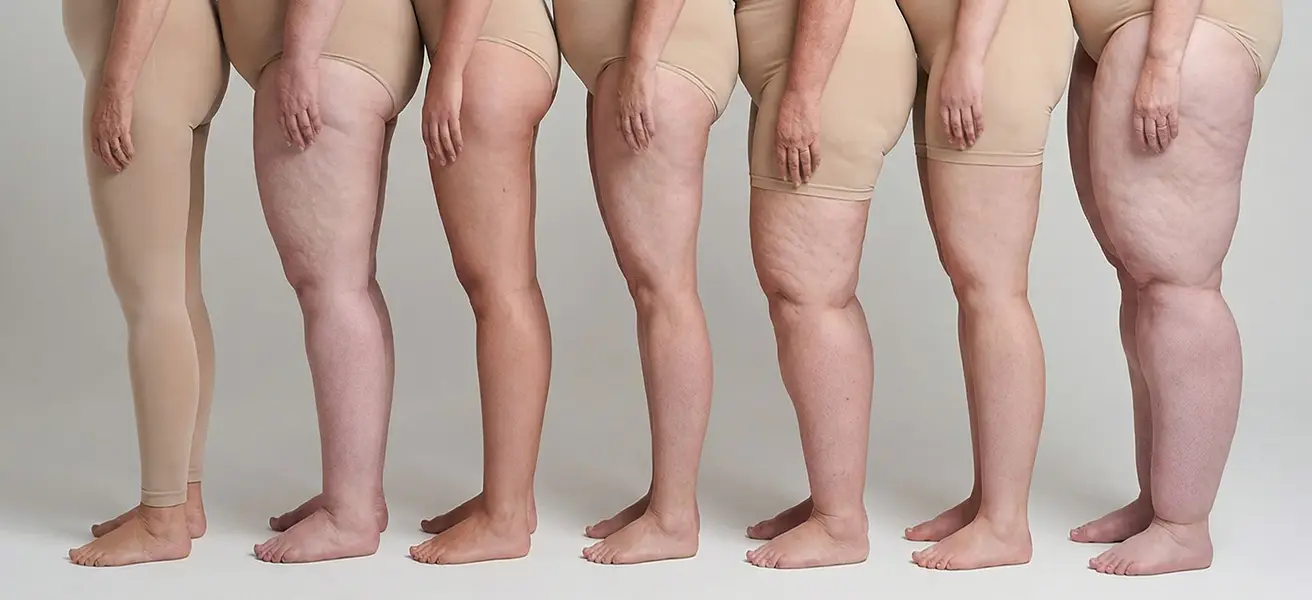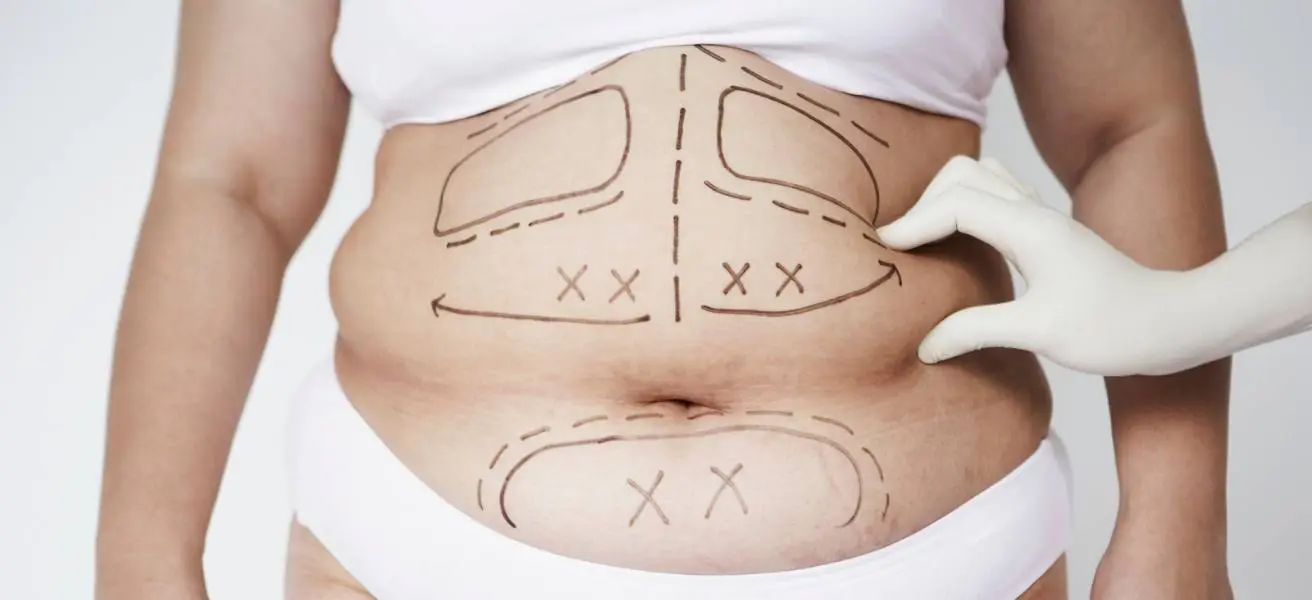
Like any other surgery, liposuction, which has many wonderful benefits, is not without potential risks, side effects and complications.
Table of Contents
Lipedema is a chronic condition where painful, nodular fat builds up in the legs and arms (sparing hands and feet). Conservative care (compression, MLD, diet, low-impact exercise) eases symptoms, but liposuction is described as the gold standard for reducing pain and improving mobility. It isn’t a cure.
Key Takeaways
- Lipedema fat differs from normal fat; it is firm, nodular, tender, symmetrical on limbs, and resistant to diet and exercise.
- It can be triggered by puberty, pregnancy, or menopause and requires an in-person diagnosis through specific tests.
- Lipedema liposuction shows significant benefits, with a study indicating 68% of women experienced substantial leg pain relief after 12 months compared to only 8% with conservative therapy.
- DEXA scans help with diagnosis and progress tracking because they measure fat distribution. Recovery involves about 1 - 2 weeks of downtime, with 1-2 months of compression and ongoing low-impact exercise.
- Choosing a qualified doctor is crucial, as not every liposuction doctor has experience treating lipedema. Surgery is day surgery and typically not covered by insurance in Singapore.
What is lipedema?
Lipedema, sometimes called “the fat disease”, is a chronic condition in which excess fat builds up, usually in the buttocks, thighs, lower legs, and arms. It can affect people of a healthy weight, not only people who are obese [1]. Common symptoms include:
- Bruising, discomfort, and spider veins in affected areas [1]
- Reduced mobility
- Psychological effects such as low self-esteem
- Leg swelling that worsens during the day and improves overnight [2]
For some individuals, symptoms can be eased with an anti-inflammatory diet, regular low-impact exercise, Manual Lymphatic Drainage (MLD) therapy, and 24/7 compression garments. However, researchers have repeatedly shown that liposuction is the gold standard for lipedema treatment [3].
How is lipedema fat different from normal fat?
Lipedema fat is firm, nodular, and painful, while normal subcutaneous fat is soft, smooth, and painless.
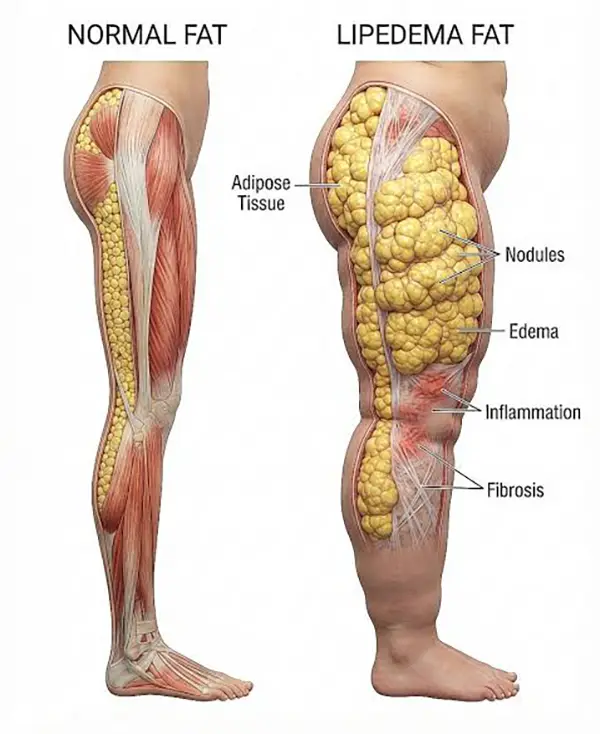
| Feature | Lipedema fat | Normal subcutaneous fat |
|---|---|---|
| Distribution | Symmetrical on the legs and arms, stopping at the wrists and ankles; hands and feet are not affected | Distributed more evenly across the face and body |
| Texture and structure | Firm, nodular, lumpy; feels like grains of sand, peas, or larger walnuts | Soft, smooth, pliable |
| Pain and sensitivity | Tender, painful, or hypersensitive even to light touch; bruises easily | Painless; does not bruise easily |
| Response to diet and exercise | Weight loss may ease symptoms, but abnormal fat layers on affected areas are unlikely to resolve | Responds to a calorie deficit and regular aerobic exercise, though stubborn pockets may persist |
| Hormonal triggers | Symptoms triggered during puberty, pregnancy, or menopause | Fluctuates with general weight gain or loss, ageing, and metabolic shifts |
Lipedema pre-op assessment & liposuction at a glance
During consultations for patients with lipedema, the following assessment will be conducted and evaluated to ensure an accurate diagnosis:
- A thorough medical history and clinical assessment, which includes the Stemmer's test and Pinch test.
- Laboratory blood tests to identify potential causes of the condition.
- Ultrasound Doppler examination to check for venous thrombosis.
- DEXA scan may be conducted to evaluate and monitor fat distribution prior to surgery.
| Treatment | Lipedema liposuction |
|---|---|
| Goal | Remove diseased, fibrotic fat to reduce pain and swelling and improve mobility and quality of life |
| Target areas | Any affected areas such as, Upper and lower arms, inner and outer thighs, knees, calves, ankles |
| Sessions | Depends on the areas to be treated. |
| Surgery time | A few hours |
Lipedema recovery: Must do
Depending on treated areas and severity of the lipedema condition, lipedema recovery involves ongoing MLD, longer compression, and dietary changes to protect lymphatic function.
| Manual lymphatic drainage (MLD) | Regular sessions with a therapist experienced in lipedema, plus self-massage twice daily, followed immediately by compression garments [5] |
| Compression therapy | 1 - 2 months to manage fluid and prevent oedema, lymphedema, and scar tissue |
| Downtime | About 1 - 2 weeks; swelling, mobility, and tissue settling keep improving for up to 6 months |
| Diet | LCHF (low-carbohydrate, high-fat), anti-inflammatory diet with reduced sodium; weight gain can make the condition harder to manage, so keep a stable, ideal weight |
| Exercise | Low-impact, water-based activity a few times a week; avoid heavy workouts |
What can you realistically expect from lipedema liposuction? What the research shows

Lipedema liposuction can reduce pain and improve mobility Research shows liposuction significantly reduces lipedema pain and improves quality of life. Conservative treatments such as lymphatic drainage and compression mainly help with swelling, and the benefit may be short-term.
Proven improvements in patients with lipedema post-lipo [8]
- Leg volume fell by about 7%.
- Average pain dropped from 7.2 to 2.1.
- Quality-of-life scores improved from 8.7 to 3.6.
- Both improvements were statistically significant.
Long-term follow-up of 25 patients and 72 procedures [9]
- Patients completed a standardised questionnaire before surgery and at two follow-ups, the first on average 16 months after surgery and the second 37 months later.
- Pain, pressure sensitivity, bruising, and quality of life improved significantly and the gains were maintained at the second follow-up.
- After excluding four patients who had not completed full preoperative CDT, the need for Complete Decongestive Therapy (CDT) fell significantly.
- Treating patients earlier in the disease may lead to better long-term outcomes.
Randomised controlled trial in Germany (410 women, 11 centres) [10]
- Lipedema is a painful, long-term condition that mostly affects women. The standard treatment, CDT helps but does not always relieve symptoms.
- After up to 7 months of conservative therapy, participants were randomised to liposuction or continued conservative therapy.
- At 12 months, 68% of the liposuction group reported significant leg pain relief, compared with 8% of the conservative group.
- Liposuction has a higher rate of serious side effects, but may still be a valuable option for patients seeking pain relief.
How to find a good lipedema liposuction doctor in Singapore?
Not every MOH-accredited liposuction doctor is qualified to treat lipedema. The surgery requires specialised training, experience, and a deep understanding of the lymphatic system.
Questions to ask a prospective doctor:
- How many lipedema patients have you treated?
- Do you use lymph-sparing surgical techniques?
- How do you preserve lymphatic function?
- Do you provide comprehensive pre- and post-op care?
Stats a good lipedema doctor can give you:
- Total lipedema cases
- Cases in the past year
- Full-leg or full-arm procedures performed
Also ask whether they have treated a wide range of body types and disease stages, managed mixed presentations, and successfully treated dense, fibrotic fat in patients who have lived with the condition for decades. Recent case frequency matters: doctors who treat lipedema often tend to have better systems, smoother recoveries, and lower complication rates. Your results and long-term health depend on the right expertise.
FAQ
Can I diagnose lipedema or determine my stage online?
No. Diagnosis needs a physical examination of skin nodularity, texture, and oedema, which cannot be done virtually.
How can I tell lipedema from “just fat legs”?
Women commonly store fat in the thighs, hips, and buttocks, so the key is whether it exceeds the typical range. Lipedema fat is also tender, bruises easily, is nodular, and spares the hands and feet. A doctor’s examination confirms the diagnosis.
What causes lipedema?
The cause is generally unknown. It mostly begins during puberty, pregnancy, or after menopause, which suggests hormones play a role. Some evidence also suggests genetics may contribute.
Can lipedema cause cold skin?
Yes. Cold skin is a common symptom, due to reduced blood flow and vascular changes.
How long does lipedema liposuction take?
Lipedema liposuction in Singapore by Dr Ivan Puah usually takes about 2 hours.
Will I be hospitalised after surgery?
No. It is a day surgery, and you go home after you wake up. Arrange for a trusted friend or family member to take you home, as you cannot drive and may feel groggy.
What are the stages of lipedema, and do they affect cost?
Lipedema is categorised into stages by severity. Higher stages increase surgical complexity, which affects the total cost.
Is lipedema liposuction covered by insurance in Singapore?
No. Lipedema treatments are not covered by insurance or MediSave in Singapore.
LEARN MORE ABOUT LIPEDEMA SURGERY
This painful fat syndrome can be effectively addressed through Lipedema Surgery to remove sick fat, relieve pain, slow progression, and improve quality of life.
Reference
[1] Mortada H, Alhithlool AW, AlBattal NZ, Shetty RK, Al-Mekhlafi GA, Hong JP, Alshomer F. Lipedema: Clinical Features, Diagnosis, and Management. Arch Plast Surg. 2025 May 15;52(3):185-196. doi: 10.1055/a-2530-5875. PMID: 40386000; PMCID: PMC12081092. https://pmc.ncbi.nlm.nih.gov/articles/PMC12081092/
[2] Dal'Forno-Dini T, Birck MS, Saalfeld RM, Macedo CLD, Bagatin E. Lipedema: pathophysiological insights and therapeutic strategies - An update for dermatologists. An Bras Dermatol. 2026 Jan-Feb;101(1):501270. doi: 10.1016/j.abd.2025.501270. Epub 2026 Jan 8. PMID: 41512532; PMCID: PMC12816854. https://pmc.ncbi.nlm.nih.gov/articles/PMC12816854/
[3] Amato AC, Amato JL, Benitti D. Efficacy of Liposuction in the Treatment of Lipedema: A Meta-Analysis. Cureus. 2024 Feb 29;16(2):e55260. doi: 10.7759/cureus.55260. PMID: 38558609; PMCID: PMC10981502. https://pmc.ncbi.nlm.nih.gov/articles/PMC10981502/
[4] Munoz J, Fons S, Fabbri M. Optimizing Liposuction in Lipedema Patients: A Novel Approach with Perioperative and Intraoperative Ultrasound. Aesthetic Plast Surg. 2026 Jul;50(13):5181-5188. doi: 10.1007/s00266-026-05889-x. Epub 2026 May 11. PMID: 42115414; PMCID: PMC13433453. https://pmc.ncbi.nlm.nih.gov/articles/PMC13433453/
[5] Czerwińska M, Gruszecki M, Rumiński J, Hansdorfer-Korzon R. Evaluation of the Effectiveness of Compression Therapy Combined with Exercises Versus Exercises Only Among Lipedema Patients Using Various Outcome Measures. Life (Basel). 2024 Oct 22;14(11):1346. doi: 10.3390/life14111346. PMID: 39598145; PMCID: PMC11595849. https://pmc.ncbi.nlm.nih.gov/articles/PMC11595849/
[6] Marxen T, Shauly O, Goel P, Tsan T, Faria R, Gould DJ. The Utility of Lymphatic Massage in Cosmetic Procedures. Aesthet Surg J Open Forum. 2023 Feb 28;5:ojad023. doi: 10.1093/asjof/ojad023. PMID: 36998743; PMCID: PMC10045879. https://pmc.ncbi.nlm.nih.gov/articles/PMC10045879/
[7] Buso G, Favre L, Vionnet N, Gonzalez-Rodriguez E, Hans D, Puder JJ, Dubath C, Eap CB, Raffoul W, Collet TH, Mazzolai L. Body Composition Assessment by Dual-Energy X-Ray Absorptiometry: A Useful Tool for the Diagnosis of Lipedema. Obes Facts. 2022;15(6):762-773. doi: 10.1159/000527138. Epub 2022 Oct 28. PMID: 36310013; PMCID: PMC9801362. https://pmc.ncbi.nlm.nih.gov/articles/PMC9801362/
[8] Rapprich, S., Dingler, A. and Podda, M. (2011), Liposuction is an effective treatment for lipedema–results of a study with 25 patients. JDDG: Journal der Deutschen Dermatologischen Gesellschaft, 9: 33-40. https://doi.org/10.1111/j.1610-0387.2010.07504.x
[9] Dadras M, Mallinger PJ, Corterier CC, Theodosiadi S, Ghods M. Liposuction in the Treatment of Lipedema: A Longitudinal Study. Arch Plast Surg. 2017 Jul;44(4):324-331. doi: 10.5999/aps.2017.44.4.324. Epub 2017 Jul 15. PMID: 28728329; PMCID: PMC5533060. https://www.thieme-connect.com/products/ejournals/html/10.5999/aps.2017.44.4.324
[10] Podda, M., Schmidt, J., Cornely, M. E., Steinmetz, M. I., Rajewski, D., Busch, K. H., ... & Cornely, O. A. (2026). Liposuction versus conservative therapy for patients with lipoedema in Germany: a multicentre, randomised controlled clinical trial. The Lancet, 408(10558), 910-923. https://www.thelancet.com/journals/lancet/article/PIIS0140-6736(26)00910-4/fulltext
[Figure Image 1] Wiedner, M., Aghajanzadeh, D., & Richter, D. F. (2020). Differential diagnoses and treatment of lipedema. Plastic and Aesthetic Research, 7, N-A.
No reference