Who qualifies for breast fat transfer in Singapore? Check health criteria, donor fat, contraindications and timing after pregnancy.
October 26, 2026


Public parking available or drop off along Arab Street, Village Hotel Bugis (Previously known as Golden Landmark Hotel)
Buses (2, 12, 32, 33, 130, 133, 133A, 520, 960, NR7) MRT (alight at Bugis MRT station)


Before we look at fat reduction options such as Vaser Lipo and fat freezing, let's understand how our bodies utilise and store energy from the food we consume.

Vaser Liposuction is a surgical, ultrasound-assisted technique that removes over 90% of localised fat in a single session and also tightens skin via collagen stimulation. Fat freezing (cryolipolysis) is non-surgical, requires multiple sessions, only reduces up to 20-25% of localised fat per session, and carries a rare but permanent risk called Paradoxical Adipose Hyperplasia (PAH), which can only be corrected with liposuction.
Calorie-counting, weight training, and intermittent fasting can improve overall body composition, but they rarely touch localised stubborn fat, the pockets around the belly, thighs, and arms that persist no matter how strict the diet or training plan.
Both Vaser Liposuction and fat freezing (cryolipolysis) are dedicated fat-reduction treatments designed to address this. Neither is gender-specific, men and women can pursue both, but the ideal candidate for either treatment has a stable, near-ideal body weight and reasonably good skin elasticity; individuals struggling with obesity are generally not ideal candidates for either.
Excess calories are stored in the body as adipose (fat) tissue. When you lose weight, your body loses fat and muscle, but not proportionately across every area. Genetics, age, and gender all influence where fat is lost first (which is why one person's belly shrinks first while another's chest reduces first). Because of this, diet and exercise alone can't reliably target one specific area, only a dedicated fat-reduction procedure can meaningfully reduce localised fat in a chosen area.
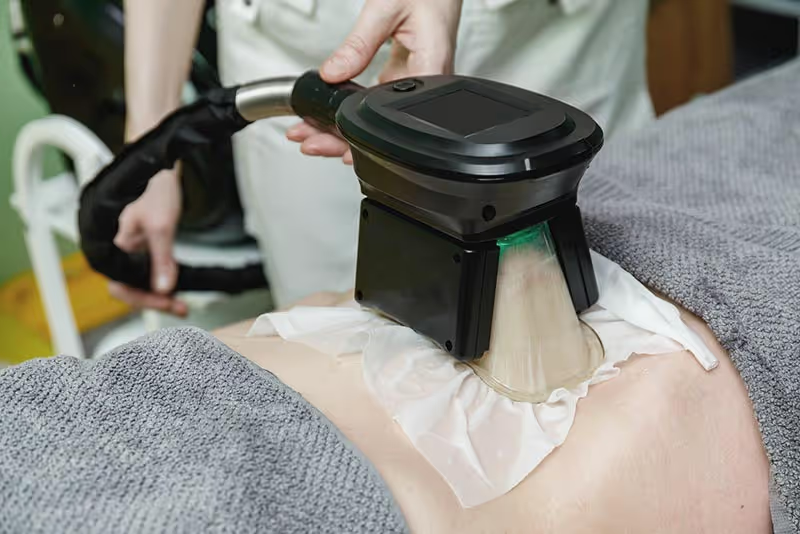
Fat freezing is a non-surgical fat-reduction treatment that uses a handheld device to vacuum the targeted area and apply subzero temperatures, freezing the fat cells beneath the skin. The body then naturally metabolises and expels the frozen fat cells as waste over time.
Expected side effects: redness, swelling, mild bruising, and discomfort similar to Delayed-Onset Muscle Soreness (DOMS) after an intense workout, all of which typically subside on their own.
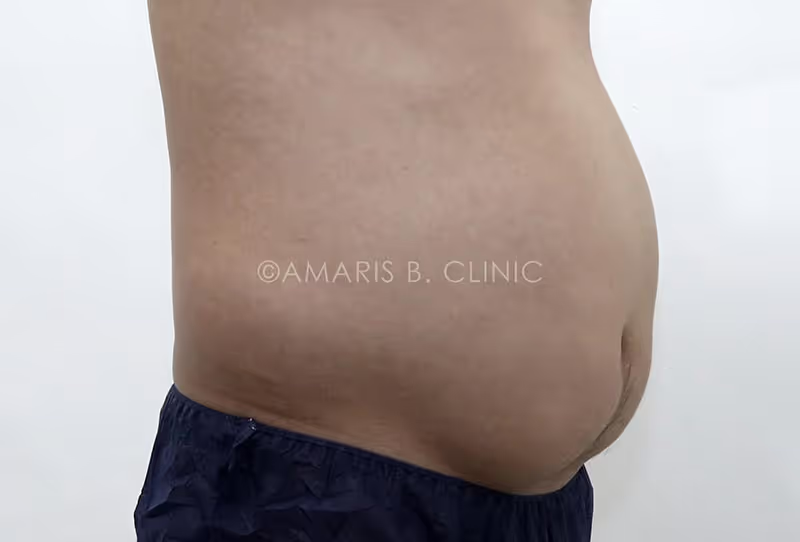
PAH is a rare fat freezing complication where, instead of shrinking, the treated area hardens and grows larger and more tender over time. Beyond the physical discomfort of disproportionate, lumpy tissue, PAH can also cause real emotional distress and loss of confidence as it progresses.
The incidence of PAH is higher than initially anticipated. Some estimates suggest it may occur in up to 2% of treatments (1 in 50 cases), while other studies report a pooled incidence of 0.22%. The exact figure remains debated but the risk is real and well-documented.
Once formed, PAH is permanent and can only be corrected surgically, with liposuction or Vaser Liposuction. There is no non-surgical fix.
Vaser (Vibration Amplification of Sound Energy at Resonance) Liposuction is an ultrasonic-assisted liposuction technique, introduced to Singapore in 2008 by Dr Ivan Puah and two other doctors. It's considerably less traumatic and less painful than traditional liposuction, because it selectively targets fat tissue while leaving connective tissue and blood vessels relatively undisturbed, meaning less bruising and shorter downtime.
| Vaser Liposuction | Fat Freezing (Cryolipolysis) | |
|---|---|---|
| Type | Surgical (Day surgery) | Non-surgical |
| Fat removed per session | Over 90% of localised fat | 20% - 25% of localised fat |
| Sessions needed | Typically one | Multiple, spaced 6–8 weeks apart |
| Time to see results | Immediate | 3–6 months |
| Skin tightening effect | Yes, stimulates collagen production | No |
| Risk of PAH | N/A (used to treat PAH) | Rare but permanent if it occurs |
Dr Ivan Puah, MOH-accredited liposuction doctor and Chairman of the Liposuction Peer Review Committee, explains the practical difference:
"In most cases, surgical fat removal yields immediate visible results since more than 90% of localised fat is removed in one surgical session. On the other hand, non-surgical fat reduction claims to only reduce up to 25% of localised fat."
He adds that the need for multiple non-surgical sessions "can inevitably lead to patient complaints, a drop in a patient's satisfaction rate, and higher costs."
One further advantage: Vaser Liposuction stimulates collagen production and skin tightening, a benefit fat freezing does not offer. This means patients can achieve permanent fat removal and skin firming from a single surgical session.
It depends on your goals. Vaser Liposuction removes over 90% of localised fat in a single session with immediate results and added skin-tightening benefits. Fat freezing is non-surgical but only reduces up to 20% - 25% of fat per session, requires multiple treatments, and takes 3–6 months to show results.
PAH is a rare fat freezing complication where the treated area hardens and enlarges instead of shrinking. It's permanent once formed and can only be treated surgically, through liposuction or Vaser Liposuction.
No. Unlike Vaser Liposuction, which stimulates collagen production, fat freezing does not have a skin-tightening effect.
Both treatments suit men and women at a near-ideal body weight with reasonably good skin elasticity. Individuals struggling with obesity are generally not ideal candidates for either procedure.
Fat freezing typically requires multiple sessions, spaced 6–8 weeks apart. Vaser Liposuction typically achieves its result in a single surgical session.
It must be performed by an MOH-accredited liposuction doctor in an MOH-approved day surgery centre or hospital.