


Facial fat grafting in Singapore starts at SGD 3,500. Prices vary based on doctor's experience, etc. Fat grafting provides a more natural appearance.
October 4, 2026


Public parking available or drop off along Arab Street, Village Hotel Bugis (Previously known as Golden Landmark Hotel)
Buses (2, 12, 32, 33, 130, 133, 133A, 520, 960, NR7) MRT (alight at Bugis MRT station)


Many women are conscious of the "bulge" that spills out. Do you know that the bulge could be armpit fat, axillary accessory breasts, OR BOTH?

Accessory breast is the extra breast tissue that can develop in areas like your armpit (most common), inner thighs, groin, and abdomen. This medical condition is caused by incomplete regression of embryonic milk-like tissue during fetal development. Comes in 8 different grades; an accessory breast can look like armpit fat or other medical conditions. An accurate diagnosis is essential to ensure appropriate treatment. It can lead to pain, chafing, and a negative impact on self-confidence.
Medically known as polymastia, supernumerary breast and ectopic breast tissue, an accessory breast is an extra breast tissue that is caused by the incomplete regression of the embryonic milk line, a mammary ridge, during fetal development, leading to accessory breasts (polymastia) or accessory nipples (polythelia).
The accessory breast was classified by Kajava et al. in 1915 based on the composition of aberrant tissues.
| Grading | Description |
|---|---|
| Grade I | Consists of a complete breast with a nipple, areola, and glandular tissue. |
| Grade II | Consists of glandular tissue and nipple without the areola. |
| Grade III | Consists of glandular tissue and areola without the nipple. |
| Grade IV | Consists of only glandular tissue. |
| Grade V | Consists of only nipple and areola, without glandular tissue. |
| Grade VI | Consists of only the nipple. |
| Grade VII | Consists of only the areola. |
| Grade VIII | Consists of only hair. |
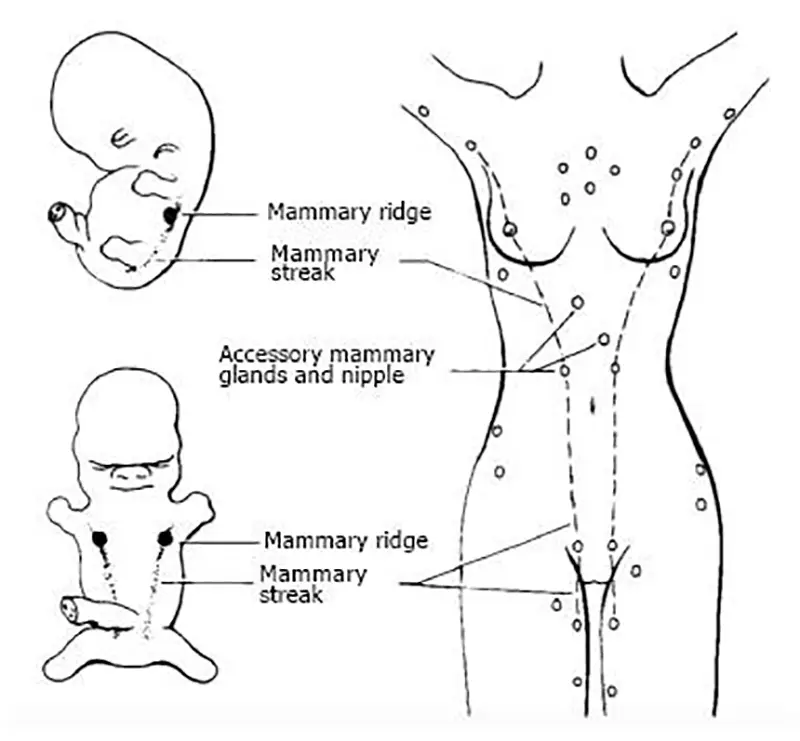
In humans, milk lines are thickened areas of skin that develop along the front of the body early in embryonic development, forming before sexual differentiation, which is why males have nipples, too.
The milk line begins to develop in the 5th to 6th weeks of the embryo, extending from the axilla to the abdomen area in both males and females.
Around 6 to 8 pairs of primordial breasts may develop from the axilla to the groin and inner thighs during the human embryonic phase [1].
The breast and nipple develop along this line in the pectoral region.
After these lines form, the primordial breasts and the mammary ridge mostly disappear, leaving behind the breast and nipple in the pecs area.
However, some (men and women alike) can develop more than two breasts along these lines. This is due to incomplete regression of the milk line.
The extra breast development is called an accessory breast. Some people may also have more than one accessory breast, nipple, hair patch or areola.
This explains why an accessory breast is not a fat pad, does not respond to diet and exercise, and is also influenced by hormones.
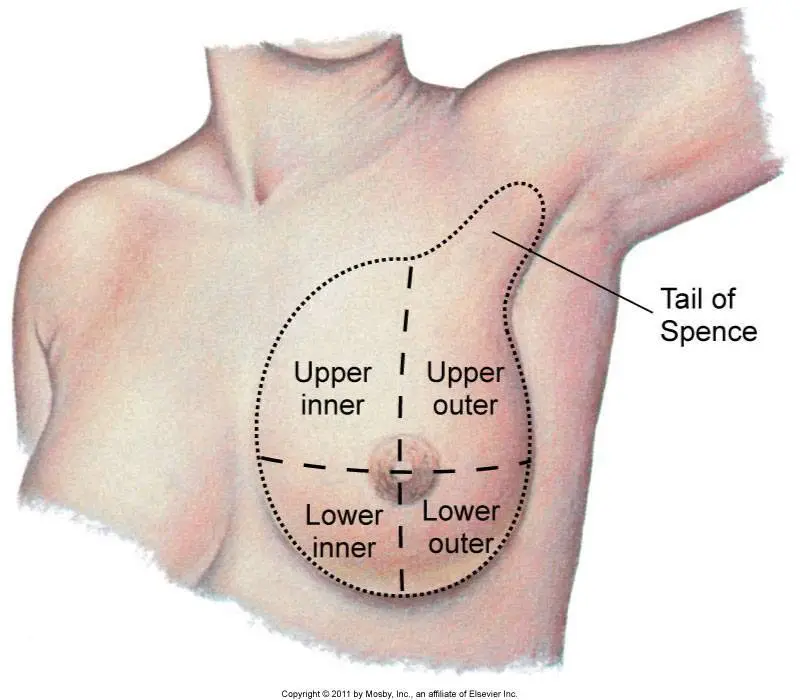
The Tail of Spence (or axillary tail) is the normal extension of breast tissue extending into the armpit (axilla) from the upper outer quadrant of the breast.
It is a normal anatomic variation that can become more prominent during menstruation, pregnancy or lactation.
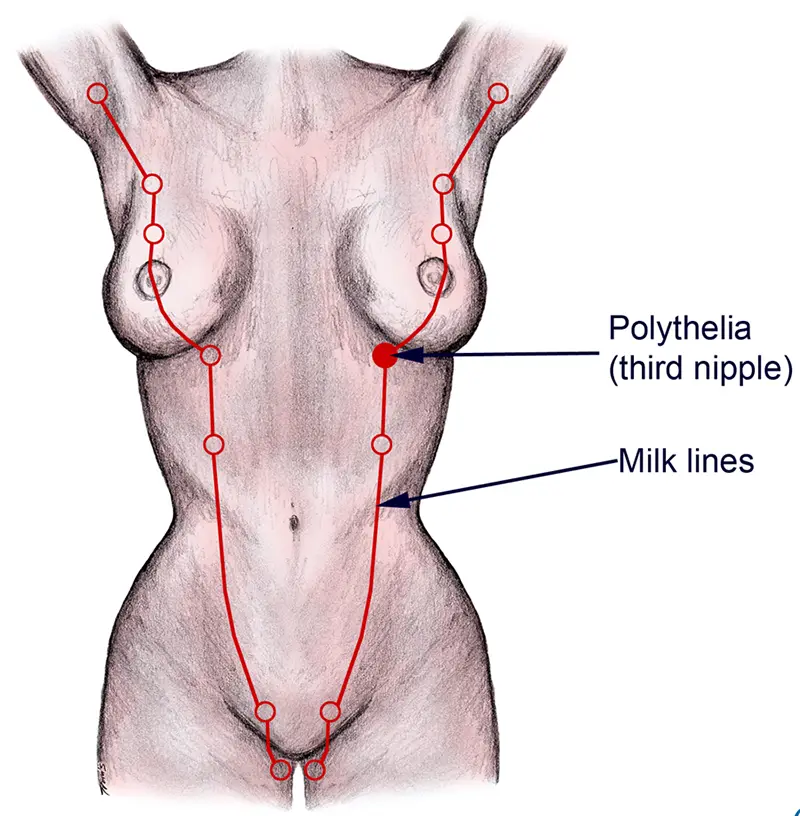
The most common location of an accessory breast is in the axillary or armpit area.
The axillary area is particularly prone to the development of accessory breasts because it is the region closest to the original mammary ridge.
In some cases, accessory breasts can appear on the chest wall, either symmetrically or asymmetrically, and may develop in conjunction with the primary breast tissue.
Some individuals may have accessory breast tissue located in the vulvar region.
This can manifest as small additional lumps of breast-like tissue that might not fully develop or as larger nodules during puberty or pregnancy.
Accessory breasts can be found along the inner thighs as well. It will show up as a small bulge, akin to breast-like protrusions.
This tissue that is located in the inner thighs can sometimes lead to discomfort or chafing, especially with movement.

This congenital condition occurs in approximately 2-6% of women, often located bilaterally, and 1-3% of men — just take actor Mark Wahlberg, who's been open about having an extra nipple!
Studies have shown that accessory breasts occur more frequently in the Japanese population.
In Caucasians, it has been reported to occur in 0.06% of cases [2].
As this tissue can contain glands, ducts, and even nipples, it may function similarly to a regular breast, becoming more noticeable during hormonal changes such as puberty, menstruation, or pregnancy.
Active accessory breast tissue can produce milk during lactation because it contains functional glandular tissue.
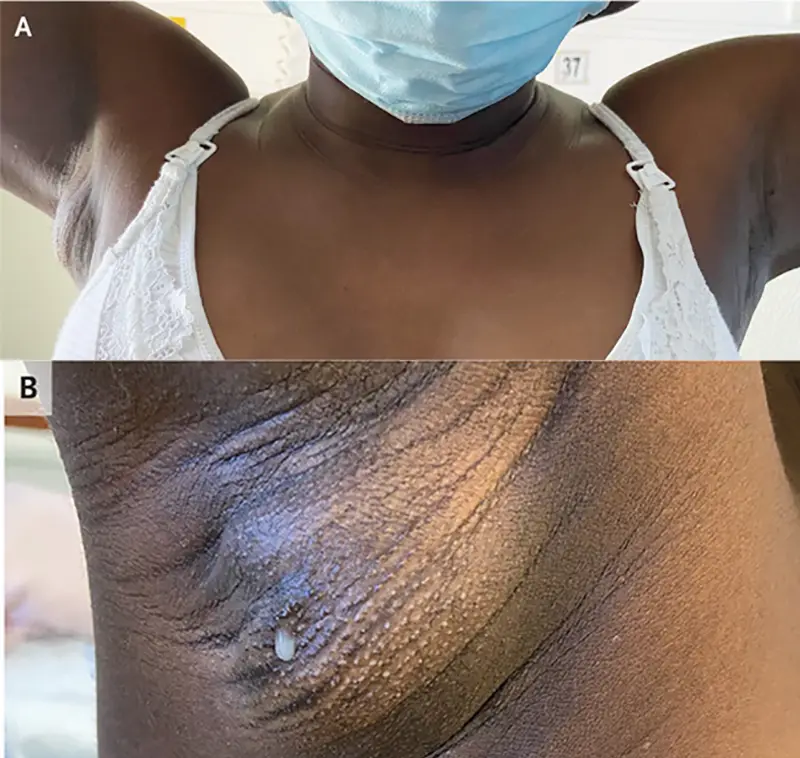
In Portugal, a 26-year-old woman started lactating from her armpit two days after giving birth.
She felt pain in her right armpit, and doctors found a round mass that released a white discharge when pressed.
Diagnosed with polymastia, which means she has extra breast tissue, many do not realise they have this extra tissue until pregnancy or breastfeeding occurs.
Milk can develop in the extra tissue, leading to swelling or pain. Some women can pump milk from this tissue.
A study noted an 18-year-old woman who did this for eight weeks to relieve discomfort [3].

Accessory breast tissue can sometimes be mistaken for armpit fat, lymph nodes or other conditions, such as:
| Feature | Armpit Fat | Accessory Breast Tissue |
|---|---|---|
| Fat | ✓ | There may be presence of armpit fat as well as accessory breast tissue at the axillary area |
| Glandular tissue | X | ✓ |
| Pain | X | Pain, tenderness and soreness |
| Mass in armpit area | Soft fatty lump | Firm |
| Respond to hormonal fluctuation | X | May feel sore during puberty, menstruation, pregnancy, breastfeeding May also lactate during breastfeeding |
| Looks like normal breast | X | Depends on severity |
| Localised to axillary (Armpit) | ✓ | May grow anywhere along the embryonic milk line, including the armpit, abdomen, inner thigh, vulva |
This condition can lead to cosmetic concerns and discomfort.
Dr Ivan Puah notes that accessory breast tissue can significantly impact a person's self-esteem and clothing choices.
Those affected may also experience discomfort, pain, and an inability to maintain proper arm posture, and, for some, pain along the medial arm.
This can cause uncomfortable ordeals, such as having to wear specific bras and clothing while doing daily chores.
Accessory breasts can seriously affect how someone feels about themselves, not just physically but also emotionally.
Many people with this issue often feel self-conscious.
This can lead to avoiding social situations or activities they used to enjoy, causing feelings of isolation and lowered self-esteem.
Accessory breast, regardless of its location, reflects the presence of breast tissue that is not typically part of the established breast anatomy.
While accessory breasts can remain unnoticed, they can also be prominent enough to require medical attention, particularly if they become painful or aesthetically concerning.
Patients may experience body image issues or social stigma related to the presence of axillary accessory breasts.
Regular check-ups are important for anyone who has concerns about accessory breast tissue to ensure there are no complications or underlying issues.
During accessory breast removal surgery, the affected tissues will be excised and sent for further evaluation to rule out any abnormalities.
Although cancer in accessory breast tissue is extremely rare — occurring in just 0.2% to 0.6% of cases — it's essential to monitor any changes [4, 5].

Removing accessory breast tissue can significantly affect a person's life.
This surgery targets the bulge, creating a smoother appearance and helping patients feel more comfortable in their skin.
The results often go beyond the physical, boosting confidence and encouraging a more active, engaged lifestyle.
Downtime is minimal, and you'll return to your regular routine before you know it.
Improved Appearance: Say goodbye to the bulge for a smoother, more contoured look.
Increased Comfort: Helps relieve discomfort or pain caused by excess tissue.
Boosted Confidence: Many individuals feel more self-assured and willing to participate in social activities.
Enhanced Emotional Well-being: Reduces feelings of self-consciousness, leading to a happier, more fulfilling life.
If you or someone you know is grappling with the effects of accessory breast tissue, it's worth discussing options with Dr Ivan Puah.
A personalised consultation can shed light on effective treatments leading to a more positive self-image and improved quality of life.


