Who qualifies for breast fat transfer in Singapore? Check health criteria, donor fat, contraindications and timing after pregnancy.
October 26, 2026


Public parking available or drop off along Arab Street, Village Hotel Bugis (Previously known as Golden Landmark Hotel)
Buses (2, 12, 32, 33, 130, 133, 133A, 520, 960, NR7) MRT (alight at Bugis MRT station)


More people have been diagnosed with paradoxical adipose hyperplasia (PAH) in recent years as a side effect of fat freezing.

Cryolipolysis has gained popularity as a non-invasive treatment that promises fast and easy slimming results with no downtime and claims to reduce stubborn fat by 20% to 25%.
However, more people have been diagnosed with paradoxical adipose hyperplasia (PAH) in recent years.
PAH is a side effect of Cryolipolysis, where, instead of shrinking, the treated area actually grows and hardens, resulting in an increase in fat cells.
This side effect has received more attention following supermodel Linda Evangelista's revelation that she had experienced PAH and was permanently deformed.
From 2015 to early 2016, the now 56-year-old supermodel had undergone seven Cryolipolysis sessions to reduce the fat tissue around her chin.
Instead, the procedure had left her with the opposite of what she had envisioned. Evangelista tells People Magazine about her experience as she poses for the first time in five years, since retreating from the public eye after the unfortunate incident, shining light on the dangerous side effect she claims she was not warned about.
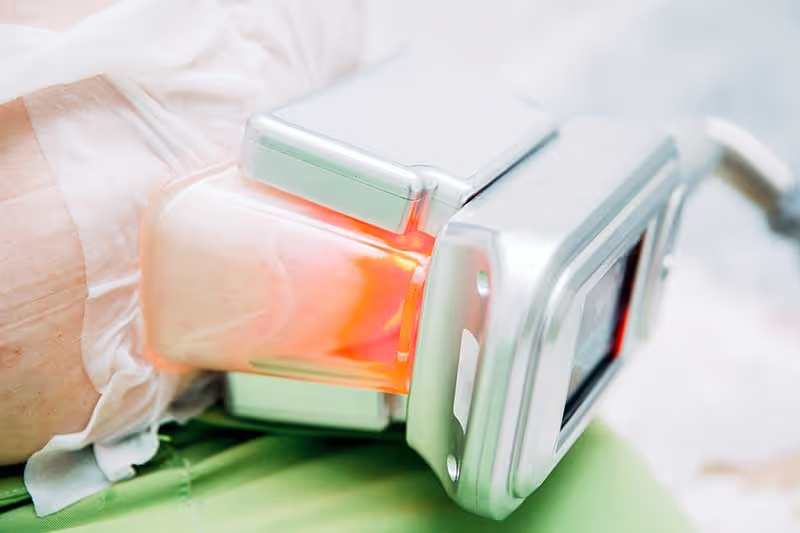
Cryolipolysis works by first isolating the areas to be treated and then using controlled cooling technologies to "kill" off the fat cells beneath the skin. During the session, fat cells are frozen and subsequently die, allowing the liver to filter them out of the body.
Although cryolipolysis is a non-invasive treatment, it is not entirely risk-free or side-effect-free. Patients should be informed about the common and significant potential side effects and complications to make more informed decisions.
The potential side effects of cryolipolysis are redness, tenderness, stinging, muscle cramping, itching, and possible diarrhoea.
Lesser-known side effects of fat freezing include:
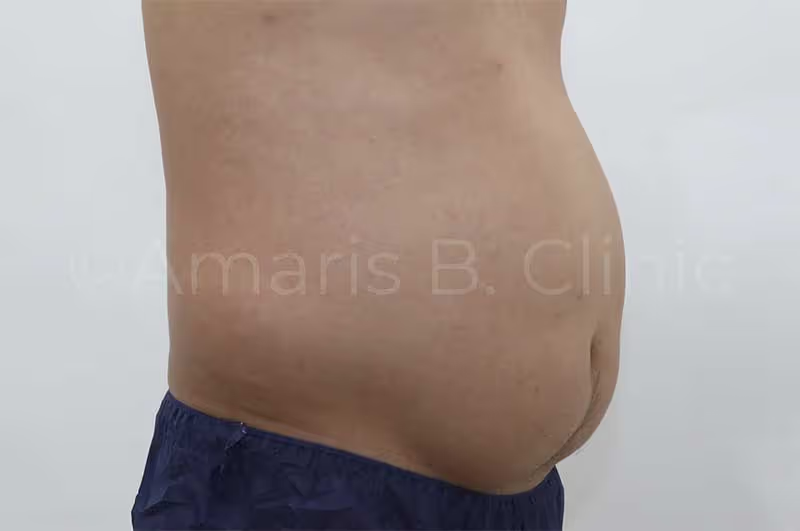
Paradoxical Adipose Hyperplasia (PAH), simply put, reverses the cryolipolysis procedure. Instead of shrinking and freezing the fat cells and destroying them, PAH increases the size of fat cells.
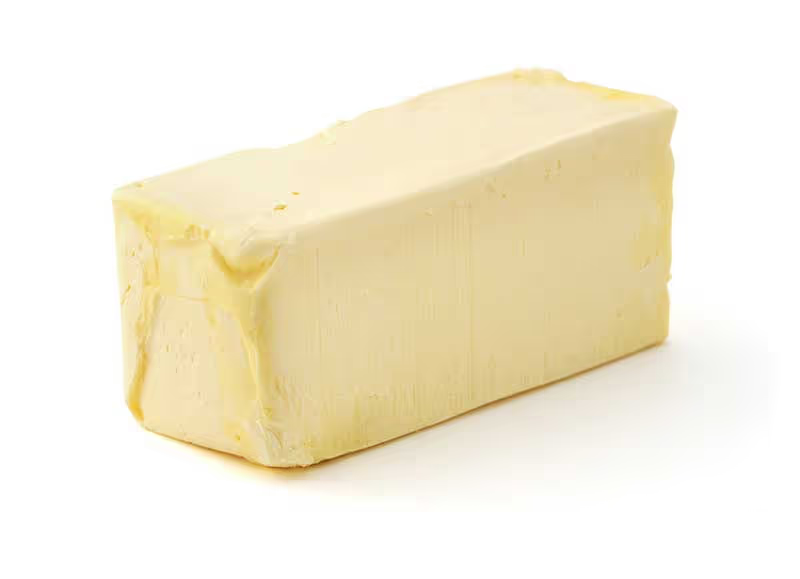
The frozen fat cells enlarge and present as painless, firm and well-demarcated fat tissues confined to the treatment area, known as the "stick of butter" effect. The skin hardens and takes the shape of the cryolipolysis applicator head.
Unfortunately, there are minimal treatment options to reverse the toughened and swollen area once PAH is developed. Liposuction, direct excision or a combination of both are the recommended corrective solutions.
Dr Ivan Puah, a liposuction doctor and Chairman of the Lipo Peer Review Committee in Singapore, who has been performing lipo and body sculpting for over 20 years, has observed a noticeable increase in Paradoxical Adipose Hyperplasia (PAH) cases in his practice in recent years.
"Technically, the first PAH case reported was in 2014 in the United States. In Singapore, with the popularity and affordability of cryolipolysis, I see more patients who have come in for a consultation with me to do corrective surgery for their PAH. Almost 60% of these patients are Singaporeans, who have spent thousands of dollars on cryolipolysis, wanting to reduce localised fat non-invasively, only to end up with toughened and swollen skin. PAH sufferers are not only physically affected, but also psychologically traumatised," explains Dr Puah.
The full effects of PAH are typically seen from one to six months following the first cryolipolysis treatment. The "stick of butter" appearance is rugged to ignore as the skin bulges over time.
"Based on the number of patients I am treating, I suspect that PAH is far more prevalent than reported because many of them are not even aware that they have it. It is an unfortunate complication that ironically affects patients who want to reduce fat without undergoing surgery," says Dr Puah.
With his years of experience in liposuction and body sculpting, Dr Ivan Puah concluded that body fat features, thickness, and distribution are unique to each person, much like our fingerprints. No two bodies are alike. Therefore, liposuction cannot be done in a cookie-cutter manner. This led Dr Puah to develop the MDC-Sculpt® Lipo technique, a novel liposuction and body contouring surgical approach.
"Typically, the fat that is removed in patients with PAH is different from other fat, and it is more challenging to remove, hence the need to utilise the MDC-SculptⓇ Lipo technique to increase the efficacy of fat removal."
If you or your loved one is suffering from PAH, here's Dr Puah's advice: You should not be treating this condition with more cryolipolysis. Consult a doctor who is experienced in performing corrective surgery, as this PAH is indeed treatable.