Dr Ivan Puah, MBBS, MOH-Accredited Lipo Doctor, Chairman of Lipo Peer Review Committee
Axillary breast tissue affects 2-6% of women and 1-3% of men. Learn the symptoms, 8 Kajava grades and 4 clinical cases, reviewed by Dr Ivan Puah.
Table of Contents
Share this
Axillary breast tissue (polymastia) is extra breast tissue that forms in the armpit. It affects about 2–6% of women and 1–3% of men. It is usually harmless, but it can cause swelling, tenderness and limited shoulder movement. It can be removed with surgery, liposuction or both.
Key takeaways
It is common and occurs in both women and men.
It becomes noticeable mostly during puberty, pregnancy and menopause.
There are eight Kajava grades. Grade IV (glandular tissue only) is the most common.
A biopsy is usually recommended to rule out abnormalities.
Surgery, liposuction or a combination all produced good results in the cases below.
What is axillary breast tissue?
Axillary breast tissue, also called polymastia or supernumerary breasts, is extra breast tissue that develops in addition to the usual breasts. It typically becomes noticeable during puberty.
It usually forms along the milk line, which runs from the chest to the groin. Less often, it appears in unusual areas such as the face, back and thighs.
It does not function like normal breast tissue. It can develop lumps and, in rare cases, become cancerous.
How common is axillary breast tissue?
About 2–6% of women and 1–3% of men have axillary breast tissue. Some people have more than one area of extra tissue.
What are the symptoms of axillary breast tissue?
Swelling and tenderness in the armpit
Thickening under the arms
Limited shoulder movement
Irritation from clothing
Symptoms often worsen during puberty and pregnancy, when breast tissue naturally develops.
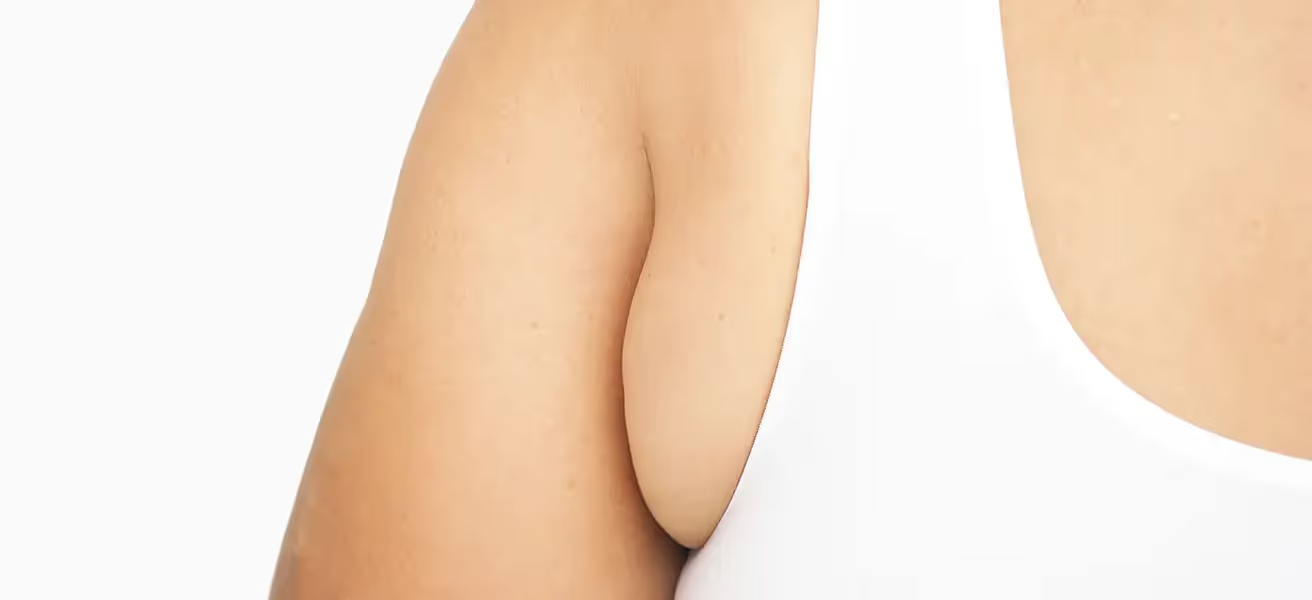
Axillary breast tissue in a female patient on her right armpit area, with no areola or nipple present
What does axillary breast tissue look like?
It appears as a lump in the armpit. It is most visible when your arms are down and feels thicker than a usual fat pocket. It can be tender or swollen during hormonal changes, which often causes cosmetic concerns.
In women: A lump in the armpit, often with no areola or nipple.
In men: It can be present with a nipple, as in the clinical photo of a male patient.
Some axillary breast tissue looks like a small breast, with an areola and nipple, so appearance varies widely.
Kajava classification: The 8 grades of axillary breast tissue
According to Kajava, there are eight grades. Grade IV is the most common.
Grade
Features
I
Complete breast: nipple, areola and glandular tissue
II
Glandular tissue and nipple, no areola
III
Glandular tissue and areola, no nipple
IV
Glandular tissue only
V
Nipple and areola, no glandular tissue
VI
Nipple only
VII
Areola only
VIII
Hair only
Axillary breast tissue in a male patient, with nipple present
Clinical case studies
Case 1: Treating axillary breast tissue in 29 women (ages 19–54)
Over 8 years, researchers treated 29 women (mean age 28.8). 16 had it on one side and 13 on both. 14 also had breast hypertrophy.
Surgical removal only: 21 patients
Liposuction only: 5 patients
Both: 3 patients
Result: All three approaches produced good results.
Case 2: Large Kajava Grade I tissue in a 72-year-old man
Presentation: A painless left armpit swelling that began about 50 years earlier at roughly lemon size. It grew beyond the armpit, causing discomfort and limiting arm movement.
Diagnosis: A stalk-like mass of 25 × 15 × 10 cm with a smooth surface and no major skin changes. Tests confirmed glandular tissue. Biopsy showed a fibrous background with normal glandular cells and some fat.
Treatment: Surgical removal.
Outcome: Surgery went smoothly and he felt relief soon after. Grade I tissue in older men is rare, so it should be considered in any long-standing armpit swelling. Early detection and treatment lead to better outcomes.
Case 3: Enlarged extra breast in a 71-year-old woman after menopause
Diagnosis: Tissue examination showed no cancer and found glandular tissue without areola or nipple (Kajava Grade IV). This presentation is rarely reported.
Treatment: Surgery to improve appearance.
Case 4: Mother in her mid-30s with armpit lumps and fat after pregnancy
Presentation: Lumps and armpit fat noticed during pregnancy. She consulted Dr Ivan Puah, an MOH-accredited liposuction doctor in Singapore with almost 20 years of body sculpting surgery experience.
Diagnosis: Axillary breast tissue and fat in both armpits.
Treatment:Axillary breast removal surgery combined with Modern Liposuction using the MDC-Sculpt® Lipo Technique, to remove the tissue and fat and tighten the skin.
Outcome: One week after surgery, incisions had healed well without complications. She was happy with the results but worried about the scars. The doctor suggested scar gel and explained that scars improve over time.
Next steps
If you notice lumps or discomfort in your armpit, consult Dr Ivan Puah to discuss diagnosis and treatment options.
FAQ
Is axillary breast tissue dangerous?
Usually not. It is generally harmless, but it can develop lumps and, rarely, become cancerous, so lumps should be checked.
Can men have axillary breast tissue?
Yes. About 1–3% of men are affected, and Case 2 describes a 72-year-old man.
Why did my armpit lump appear during pregnancy or puberty?
Hormonal changes make breast tissue develop, so symptoms often worsen at these times. Menopause can also trigger growth, as in Case 3.
How is it diagnosed?
Through physical examination, imaging and tissue analysis. A biopsy is usually recommended to rule out abnormalities, and removed tissue is sent for histological assessment.
How is it treated?
Options are surgical removal, liposuction, or both, depending on whether the lump is glandular tissue, fat or a mix.
Is it the same as armpit fat?
No. Axillary breast tissue is glandular and feels thicker than a usual fat pocket, though the two can coexist (Case 4).
Will surgery leave scars?
Incisions are made, but scars improve over time. Scar gel may be suggested.
LEARN ABOUT ACCESSORY BREAST REMOVAL
Axillary Breast Tissue occurs in women, even men. It is a medical condition that may cause discomfort and pain. In rare cases, it may be cancerous or could even
At Amaris B. Clinic, we want you to know that it's always been about you. Deciding to embark on a journey toward skin, face, body treatment, or a fitness program is significant, and we are here to prioritise your results, well-being, and safety at every step.