Wondering if you qualify for breast fat transfer? Check BMI range, health criteria, and contraindications reviewed by an MOH-accredited doctor.
September 12, 2026


Public parking available or drop off along Arab Street, Village Hotel Bugis (Previously known as Golden Landmark Hotel)
Buses (2, 12, 32, 33, 130, 133, 133A, 520, 960, NR7) MRT (alight at Bugis MRT station)


Gynecomastia (male breast enlargement) won't go away with diet or exercise. Learn the grades, causes & surgery options before starting NS in Singapore.

Getting your Full-time National Service (NS) enlistment letter is a milestone, and for some guys, it's also the moment they start worrying about their chest.
If you've been doing daily workouts hoping your "man boobs" will disappear before enlistment, here's the direct answer: Diet and exercise cannot fix gynecomastia. In fact, losing weight can make enlarged glandular tissue look more noticeable, not less.
This guide explains what gynecomastia is, how to self-check for it, how doctors grade its severity, and what your actual options are before you report for NS.
Gynecomastia is the medical term for enlarged male breast tissue, caused by an imbalance between estrogen and testosterone levels.
It is one of the most common male breast conditions, accounting for an estimated 65% of male breast disorders. It involves enlarged glandular tissue and, in many cases, excess chest fat and puffy or protruding nipples.
Key causes:
Two main types:
| Type | What’s involved |
|---|---|
| True gynecomastia | Glandular tissue only |
| Mixed gynecomastia | Glandular tissue + excess fat |
It can be bilateral (both sides) or unilateral (one side only, causing visible asymmetry).
Gynecomastia is far more common than most guys realise:
In teens, it's usually triggered by the estrogen surge of puberty but it can resolve on its own, though not always.
In adults, it's more often linked to age-related testicular hypofunction and increased body fat.
Two simple checks can give you an early indication (not a diagnosis):
Apply light pressure to the chest. A tender, firm, disc-like mound of tissue beneath the nipple suggests glandular involvement rather than just fat.
Check for any female-like breast contour or shape. Observe any swelling, soreness, tenderness or even puffy nipples.
Important: A self-check can only flag a possibility. A confirmed diagnosis requires a physical examination by a doctor experienced in treating gynecomastia.
Doctors use the Simon, Hoffman, and Kahn classification, commonly referred to as the Gynecomastia Scale, to assess male breast enlargement.
This framework is the most widely referenced for standardising diagnosis and treatment planning based on the degree of breast tissue enlargement and the presence of excess skin.

Enlarged glandular tissue can reach the visual equivalent of a C- or D-cup, with an enlarged, distorted nipple-areola complex.
Under a form-fitting NS uniform or PT shirt, this can resemble female breast contour, including droop and loose skin.
Research on body image consistently links this kind of body dissatisfaction in men to:
Because men are statistically less likely to talk openly about body-image concerns, many try to self-treat quietly, which leads to the next point.
Creams and over-the-counter pills are entirely ineffective for true glandular tissue. They cannot penetrate the dermis to reach the glandular tissue, nor can they alter local androgen-estrogen receptor activity in a targeted way.
Supplements such as zinc, magnesium, or herbal aromatase inhibitors lack clinical evidence supporting their use. Cryolipolysis (fat freezing) does not and cannot target the fibrous glandular tissue and is therefore ineffective for true gynecomastia.
Laser treatments and radiofrequency devices affect skin tightening and superficial fat, but cannot ablate dense, fibrous breast tissue.
For men with established, persistent gynecomastia, surgical intervention in the form of gynecomastia surgery is the only proven, permanent treatment.
This procedure directly addresses the root cause of the medical condition by excising the enlarged gland located deep in the nipple-areolar complex.
In patients with mixed gynecomastia, where glandular tissue coexists with excess chest fat, liposuction sculpts the surrounding chest wall, ensuring a smooth, natural transition into the pectoral contours.
The benefits of gynecomastia surgery are dual:
Dr Ivan Puah is an MOH-accredited liposuction doctor in Singapore with years of experience in gynecomastia surgery.
His background includes:
Most patients see their final, more masculine chest contour within 3 to 6 months post-surgery. Getting there requires following post-op care instructions:
Long-term results depend on maintaining a healthy lifestyle after recovery.
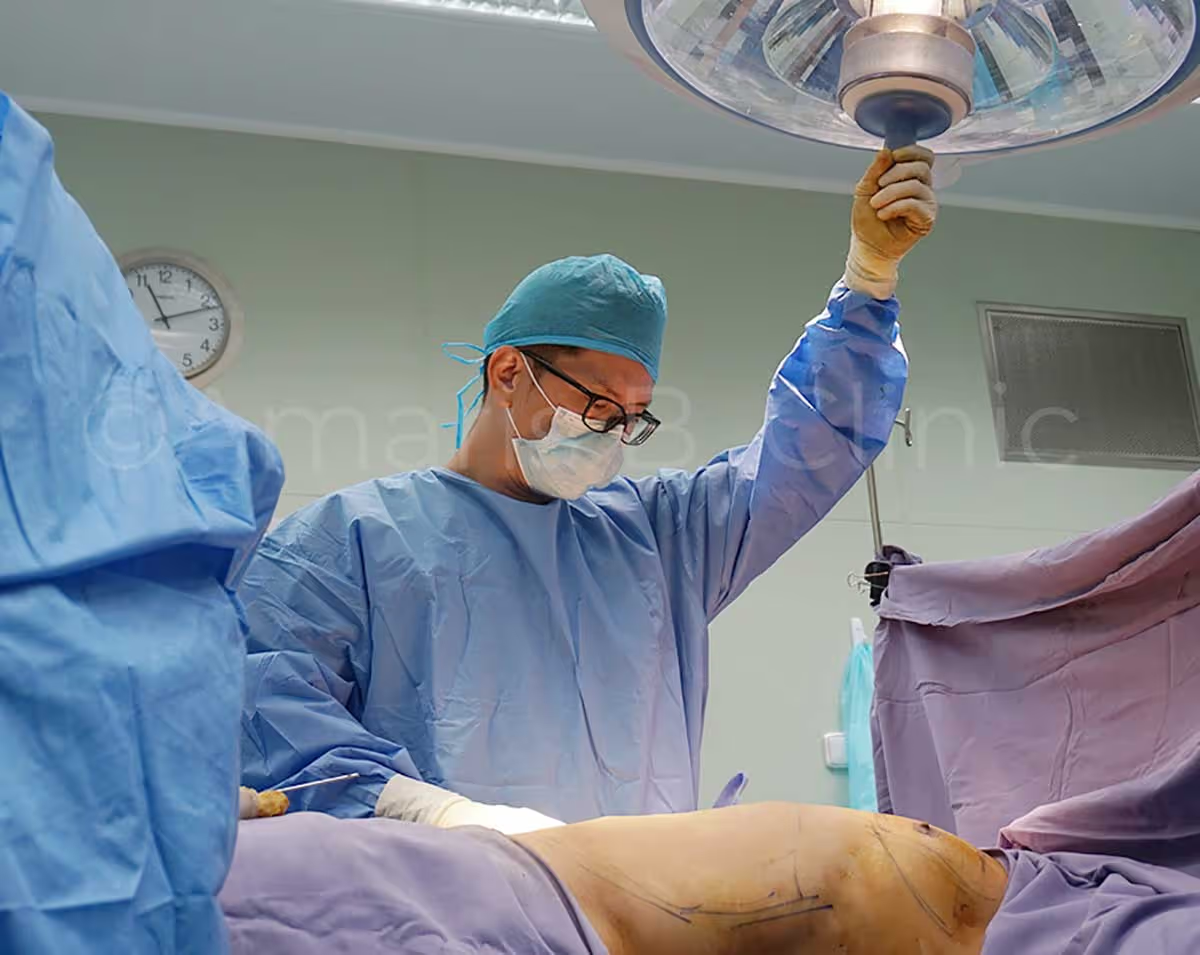
There is no single fixed price. In Singapore, gynecomastia surgery costs typically range from SGD 5,000 onwards, depending on the complexity of your condition and the surgical approach required.
The final cost is determined by several variables:
Cost should never be the sole determining factor. The performing doctor's experience with your specific gynecomastia grade, their technical approach, and your comfort level with them are equally critical to the quality and safety of your outcome.
MediSave: Singapore Citizens and Permanent Residents can use MediSave to claim the costs of gynecomastia surgery, provided the procedure is deemed medically necessary. Eligibility depends on the condition's cause, severity, and symptoms. The withdrawal amount is determined by the surgical procedure's classification under MOH's table of surgical limits, which range from $250 to $7,550 depending on the procedure table.
Insurance: Private insurance coverage is not automatic; it requires documented medical necessity. Coverage varies significantly by policy type and insurer.
It's important to consult a doctor with ample experience in gynecomastia surgery. "Ask them how frequently they perform the procedure," says Dr Puah. "It's also crucial to find a doctor who not only performs the procedure regularly, but one who can consistently achieve a high satisfaction rate. "
Not at all. Gynecomastia involves dense, fibrous glandular tissue, not fat. Exercise and caloric restriction may target adipose deposits; however, as surrounding chest fat diminishes with weight loss, the firm subareolar disc often becomes more visually prominent, making the condition appear worse rather than better.
Gynecomastia feels like a firm, rubbery, or disc-like lump directly beneath the areola. Chest fat, or pseudogynecomastia, is soft and uniform, just like fat from any part of the body.
For a confirmed diagnosis, a thorough in-person evaluation by a doctor experienced in gynecomastia is essential.

Gynecomastia is classified using the Simon, Hoffman and Kahn scale, which assesses the amount of breast tissue enlargement and skin laxity:
Many doctors and insurance institutions also reference a four-grade scale (I–IV) for broader standardisation.
No. There is no non-surgical method, such as a cream, pill, fat freezing, or laser, that removes glandular breast tissue. These products cannot penetrate the dermal barrier to reach or ablate the dense fibroglandular stroma located deep to the areola. Surgery remains the only scientifically proven, permanent treatment for established gynecomastia.
There is no fixed price. In Singapore, gynecomastia surgery costs typically range from SGD 5,000 onwards, depending on case complexity (grade), anaesthesia type, facility fees, and the performing doctor's experience. To achieve optimal masculine chest results, additional procedures such as nipple reduction or areola resizing may increase the total cost.
Results are immediately visible once the gland and excess fat are physically removed. However, postoperative swelling sets in and will temporarily obscure the final outcome. The patient's satisfaction continues to grow as swelling subsides and scars mature. Incision lines are permanent but will continue to fade over time, becoming barely visible in most cases.
In gynecomastia surgery recovery, most patients achieve their final chest contour within 3 to 6 months, as residual swelling fully resolves and tissues settle into their new position.